
Rehabilitation & Gait Training Equipment
Parallel Bar
Supported Gait & Mobility Training for Rehabilitation
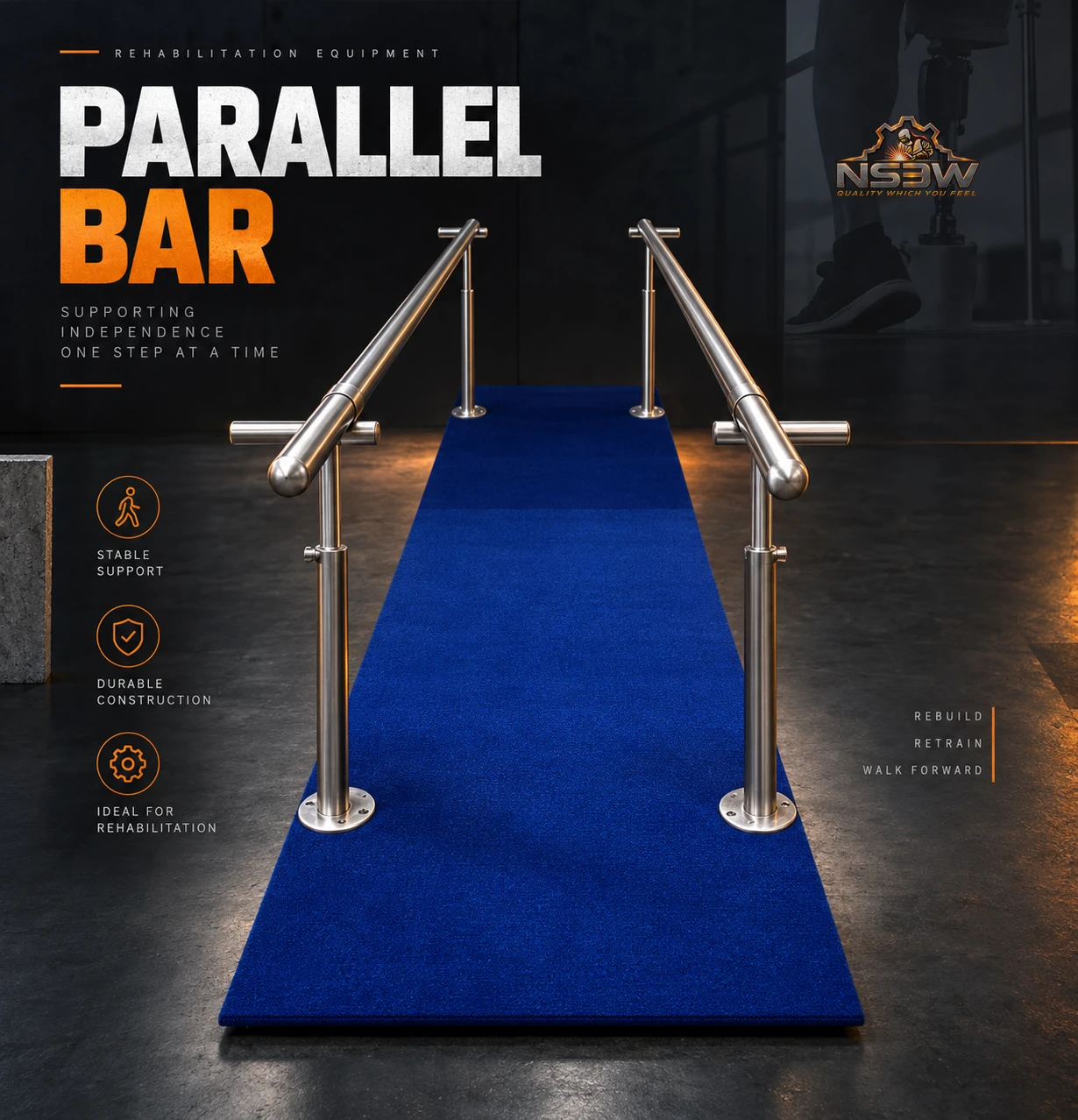
The NSEW Parallel Bar is rehabilitation equipment consisting of two parallel handrails positioned along a controlled walking area to provide support during appropriate gait, balance and mobility training.
Overview
What The Parallel Bar Does
The NSEW Parallel Bar is a rehabilitation training system designed to provide a controlled environment for appropriate gait, balance and mobility-training activities.
The system uses two parallel handrails positioned along a dedicated walking area, allowing users to access bilateral upper-limb support while performing appropriate supervised mobility activities.
Parallel bars are commonly associated with rehabilitation environments where controlled walking practice forms part of an appropriate rehabilitation programme. They may also be used in prosthetic and orthotic rehabilitation environments when individuals are practising mobility with appropriate lower-limb prosthetic or orthotic devices.
The bilateral handrail arrangement provides a support interface throughout the walking area, while the dedicated pathway creates a defined environment for professional rehabilitation activities.
The NSEW Parallel Bar is intended for professional rehabilitation centres, prosthetic and orthotic facilities, training environments and other appropriate supervised rehabilitation settings. For training involving steps, inclined surfaces and changes in level, the NSEW Ramp provides a complementary rehabilitation-training environment.
For training involving steps, inclined surfaces and changes in level, explore the NSEW rehabilitation Ramp.
Key Features
Built For Rehabilitation Training
Where It's Used
Applications
Confirmed Data
Technical Specifications
Only confirmed and general specification data is listed below. Dimensions, handrail spacing and height-adjustment range are available on enquiry.
| Product Name | Parallel Bar |
|---|---|
| Descriptive Type | Rehabilitation Parallel Bar |
| Product Type | Gait & Mobility Training Equipment |
| Product Category | Rehabilitation Equipment |
| Application | Gait, Balance & Mobility Training |
| Support Configuration | Bilateral Parallel Handrails |
| Training Area | Controlled Walking Path |
| Operation | Manual / Non-Powered |
| Power Requirement | None |
| Installation | Stationary Rehabilitation Training Equipment |
| Suitable For | Professional Rehabilitation, P&O and Training Environments |
Understanding The Product
What Are Rehabilitation Parallel Bars?
Rehabilitation parallel bars are two parallel handrails positioned along a controlled walking area. They provide bilateral support during appropriate gait, balance and mobility-training activities in professional rehabilitation environments.
How It's Used
How Are Parallel Bars Used in Rehabilitation?
Parallel bars provide a controlled environment where appropriate users can practise supported standing, walking and mobility activities while having access to handrails on both sides.
In prosthetic and orthotic rehabilitation, parallel bars may be used during appropriate supervised mobility training involving lower-limb prosthetic or orthotic devices.
The exact activities, level of assistance and rehabilitation programme depend on the individual and should be determined by the relevant rehabilitation professional.
Choosing The Right Equipment
Parallel Bar vs Rehabilitation Ramp
Parallel bars and rehabilitation ramps serve related but different roles in mobility-training environments.
Parallel bars provide a controlled level walking area with bilateral handrail support and are commonly used for appropriate supported gait and mobility activities.
A rehabilitation ramp introduces additional environmental challenges such as inclined surfaces, steps and changes in level.
Depending on the rehabilitation programme, both types of equipment may form part of a broader mobility-training environment.
Why Choose NSEW
Built By The Same Workshop, Every Time
- 15+ years manufacturing prosthetic, orthotic and rehabilitation-support equipment from Naraina Industrial Area, Delhi
- Quality-inspected in-house alongside NSEW's wider P&O and rehabilitation equipment range
- Direct manufacturer contact for product guidance and quote-ready specification support
Common Questions
Parallel Bar FAQ
What are rehabilitation parallel bars?
Rehabilitation parallel bars consist of two parallel handrails positioned along a controlled walking area to provide bilateral support during appropriate gait, balance and mobility-training activities.
What are parallel bars used for in rehabilitation?
Parallel bars provide a supported environment for appropriate standing, walking, gait and mobility-training activities within professional rehabilitation programmes.
Can parallel bars be used for prosthetic gait training?
Parallel bars may be used in appropriate lower-limb prosthetic rehabilitation programmes where supported gait and mobility training is required. Individual training requirements should be determined by the relevant rehabilitation professional.
Can parallel bars be used for orthotic rehabilitation?
They may be used in appropriate orthotic rehabilitation environments where bilateral handrail support is useful during supervised gait and mobility training.
Do rehabilitation parallel bars require electricity?
No. The NSEW Parallel Bar is non-powered rehabilitation equipment and does not require electrical power for normal use.
What support do parallel bars provide?
Parallel bars provide handrails on both sides of a controlled walking area, allowing access to bilateral upper-limb support during appropriate rehabilitation activities.
What is the difference between parallel bars and a rehabilitation ramp?
Parallel bars provide bilateral handrail support along a controlled walking area, while a rehabilitation ramp introduces additional surfaces such as inclines, steps and changes in level. The appropriate equipment depends on the rehabilitation programme.
Where are rehabilitation parallel bars used?
They are commonly used in professional rehabilitation centres, prosthetic and orthotic facilities, training environments and other appropriate rehabilitation settings.
Is a Parallel Bar a prosthetic component?
No. A Parallel Bar is rehabilitation and mobility-training equipment rather than a patient-worn prosthetic or orthotic component.
Works Alongside